 Add to Chrome
 Add to Firefox
 Add to Edge
Modeling Spectral Energy Shifts in Spatio-Temporal Graph Anomaly Detection
May 29, 2026
Graph anomaly detection methods aim to distinguish anomalous nodes. While prior methods characterize anomalies through increased variation in the spectral energy distributions, they overlook those that result in decreased variation, i.e., camouflaged anomalies that appear normal. We show that this type of anomaly persists across multiple datasets and remains undetectable by existing spectral approaches. To address this limitation, we propose a node-level spectral energy formulation that is fully compatible with message passing and enables the detection of camouflaged anomalies. Building on this formulation, we introduce an energy-aware graph learning framework that models spectral shifts through energy-driven message passing in both static and time-series graphs. Besides, our unified architecture extends to temporal settings without introducing specialized sequence modules, enabling efficient learning under long sliding windows. Extensive experiments on large-scale benchmarks demonstrate the effectiveness and scalability of our approach.

Memento: Personalized RAG-Style Long-Retention Data Scaling for META Ads Recommendation
May 22, 2026Modeling of long history data suffers from long-context window attention dilution, system efficiency and catastrophic forgetting problems, where naive linear scaling approach like LastN would fail. We introduce Memento, a personalized retrieval-augmented framework that treats historical user engagements as a document corpus and ad requests as queries, retrieving relevant interactions via Maximal Marginal Relevance (MMR) to balance similarity with diversity. We identify two complementary applications: Representation Memento, which retrieves historical embeddings for feature augmentation, and Data Memento, which retrieves past training examples for multipass training. Through infrastructure co-design -- temporal chunking, INT8 quantization, and asynchronous serving -- Memento achieves 5-10$\times$ resource efficiency over linear scaling. Memento processes daily requests with sub-10ms latency, yielding 0.25-0.3% Normalized Entropy gain on both click-through and conversion prediction. In production, Memento delivers a 1% CTR lift on Facebook Feed and Reels and a 1.2% CVR lift, scaling personalization to 365+ days of history.
CHOIR: Contact-aware 4D Hand-Object Interaction Reconstruction
May 21, 2026We ask whether everyday open-world monocular videos can be turned into reusable 4D interaction primitives: articulated hand motion, object shape with 6D pose over time, and the when/where of contact. Such a capability would enable scalable mining of real interactions and, beyond reconstruction, support scene-aware synthesis and planning. However, reconstructing hand-object interaction (HOI) from challenging monocular videos remains difficult: methods often assume known objects or curated scenes, and separately estimated hands and objects easily become misaligned under clutter, occlusion, and unseen object geometries. Targeting this setting, we present CHOIR, a Contact-aware HOI Reconstruction framework for a monocular camera, using contact as an explicit coupling signal between hands and objects. CHOIR first initializes a coarse, contact-agnostic 4D HOI sequence from open-world visual priors. It then introduces a generative HOI spatial rectification module to predict ray-depth corrections and rectify hand-object relative placement, then derive initial per-frame contact correspondences on the rectified geometry. Last, a contact-aware joint optimization with dynamically updated contact constraints enforces geometric, temporal, and contact consistency. Experiments on controlled and challenging videos show that CHOIR improves object reconstruction, physical plausibility, and temporal consistency over state-of-the-art methods.
Learning to Solve PDEs on Neural Shape Representations
Dec 24, 2025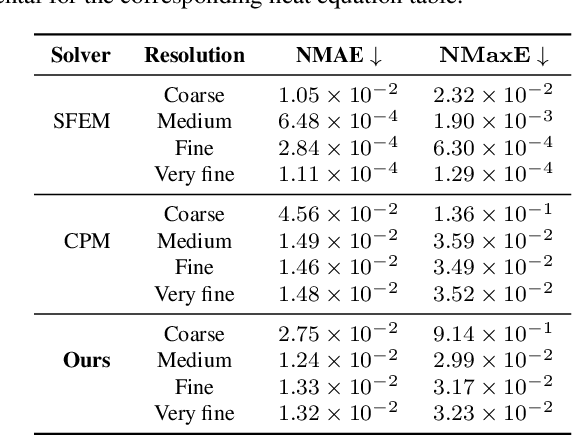
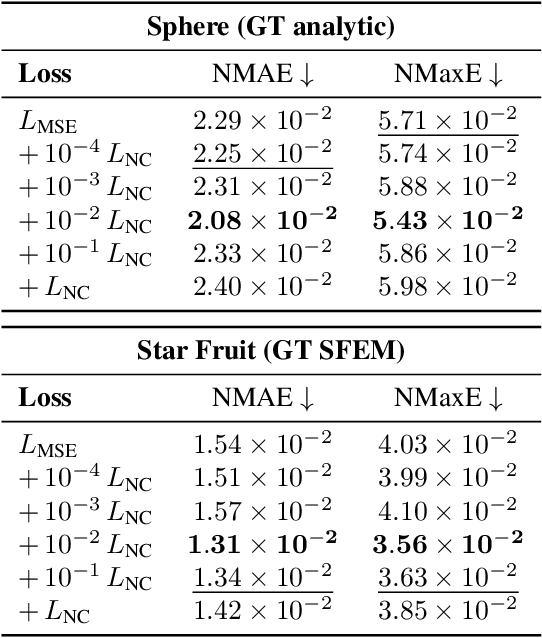
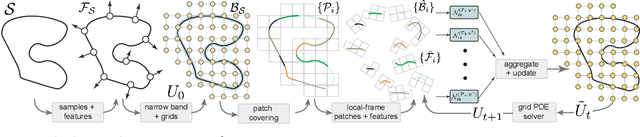
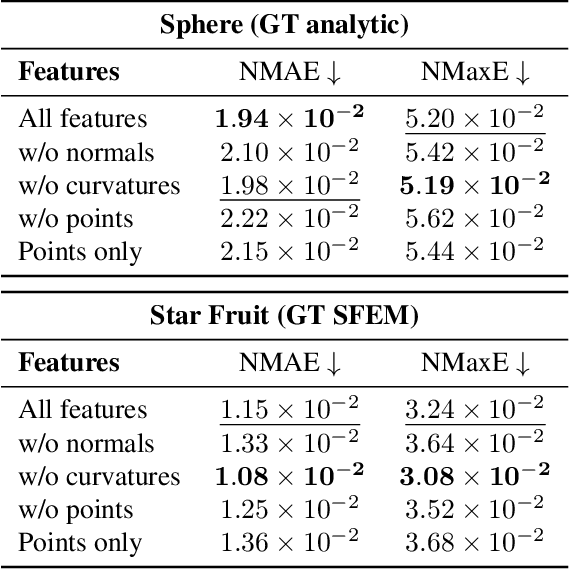
Solving partial differential equations (PDEs) on shapes underpins many shape analysis and engineering tasks; yet, prevailing PDE solvers operate on polygonal/triangle meshes while modern 3D assets increasingly live as neural representations. This mismatch leaves no suitable method to solve surface PDEs directly within the neural domain, forcing explicit mesh extraction or per-instance residual training, preventing end-to-end workflows. We present a novel, mesh-free formulation that learns a local update operator conditioned on neural (local) shape attributes, enabling surface PDEs to be solved directly where the (neural) data lives. The operator integrates naturally with prevalent neural surface representations, is trained once on a single representative shape, and generalizes across shape and topology variations, enabling accurate, fast inference without explicit meshing or per-instance optimization while preserving differentiability. Across analytic benchmarks (heat equation and Poisson solve on sphere) and real neural assets across different representations, our method slightly outperforms CPM while remaining reasonably close to FEM, and, to our knowledge, delivers the first end-to-end pipeline that solves surface PDEs on both neural and classical surface representations. Code will be released on acceptance.
NegoCollab: A Common Representation Negotiation Approach for Heterogeneous Collaborative Perception
Oct 31, 2025Collaborative perception improves task performance by expanding the perception range through information sharing among agents. . Immutable heterogeneity poses a significant challenge in collaborative perception, as participating agents may employ different and fixed perception models. This leads to domain gaps in the intermediate features shared among agents, consequently degrading collaborative performance. Aligning the features of all agents to a common representation can eliminate domain gaps with low training cost. However, in existing methods, the common representation is designated as the representation of a specific agent, making it difficult for agents with significant domain discrepancies from this specific agent to achieve proper alignment. This paper proposes NegoCollab, a heterogeneous collaboration method based on the negotiated common representation. It introduces a negotiator during training to derive the common representation from the local representations of each modality's agent, effectively reducing the inherent domain gap with the various local representations. In NegoCollab, the mutual transformation of features between the local representation space and the common representation space is achieved by a pair of sender and receiver. To better align local representations to the common representation containing multimodal information, we introduce structural alignment loss and pragmatic alignment loss in addition to the distribution alignment loss to supervise the training. This enables the knowledge in the common representation to be fully distilled into the sender.
CLR-Wire: Towards Continuous Latent Representations for 3D Curve Wireframe Generation
May 01, 2025We introduce CLR-Wire, a novel framework for 3D curve-based wireframe generation that integrates geometry and topology into a unified Continuous Latent Representation. Unlike conventional methods that decouple vertices, edges, and faces, CLR-Wire encodes curves as Neural Parametric Curves along with their topological connectivity into a continuous and fixed-length latent space using an attention-driven variational autoencoder (VAE). This unified approach facilitates joint learning and generation of both geometry and topology. To generate wireframes, we employ a flow matching model to progressively map Gaussian noise to these latents, which are subsequently decoded into complete 3D wireframes. Our method provides fine-grained modeling of complex shapes and irregular topologies, and supports both unconditional generation and generation conditioned on point cloud or image inputs. Experimental results demonstrate that, compared with state-of-the-art generative approaches, our method achieves substantial improvements in accuracy, novelty, and diversity, offering an efficient and comprehensive solution for CAD design, geometric reconstruction, and 3D content creation.
HoLa: B-Rep Generation using a Holistic Latent Representation
Apr 22, 2025We introduce a novel representation for learning and generating Computer-Aided Design (CAD) models in the form of $\textit{boundary representations}$ (B-Reps). Our representation unifies the continuous geometric properties of B-Rep primitives in different orders (e.g., surfaces and curves) and their discrete topological relations in a $\textit{holistic latent}$ (HoLa) space. This is based on the simple observation that the topological connection between two surfaces is intrinsically tied to the geometry of their intersecting curve. Such a prior allows us to reformulate topology learning in B-Reps as a geometric reconstruction problem in Euclidean space. Specifically, we eliminate the presence of curves, vertices, and all the topological connections in the latent space by learning to distinguish and derive curve geometries from a pair of surface primitives via a neural intersection network. To this end, our holistic latent space is only defined on surfaces but encodes a full B-Rep model, including the geometry of surfaces, curves, vertices, and their topological relations. Our compact and holistic latent space facilitates the design of a first diffusion-based generator to take on a large variety of inputs including point clouds, single/multi-view images, 2D sketches, and text prompts. Our method significantly reduces ambiguities, redundancies, and incoherences among the generated B-Rep primitives, as well as training complexities inherent in prior multi-step B-Rep learning pipelines, while achieving greatly improved validity rate over current state of the art: 82% vs. $\approx$50%.
Unicorn: A Universal and Collaborative Reinforcement Learning Approach Towards Generalizable Network-Wide Traffic Signal Control
Mar 14, 2025Adaptive traffic signal control (ATSC) is crucial in reducing congestion, maximizing throughput, and improving mobility in rapidly growing urban areas. Recent advancements in parameter-sharing multi-agent reinforcement learning (MARL) have greatly enhanced the scalable and adaptive optimization of complex, dynamic flows in large-scale homogeneous networks. However, the inherent heterogeneity of real-world traffic networks, with their varied intersection topologies and interaction dynamics, poses substantial challenges to achieving scalable and effective ATSC across different traffic scenarios. To address these challenges, we present Unicorn, a universal and collaborative MARL framework designed for efficient and adaptable network-wide ATSC. Specifically, we first propose a unified approach to map the states and actions of intersections with varying topologies into a common structure based on traffic movements. Next, we design a Universal Traffic Representation (UTR) module with a decoder-only network for general feature extraction, enhancing the model's adaptability to diverse traffic scenarios. Additionally, we incorporate an Intersection Specifics Representation (ISR) module, designed to identify key latent vectors that represent the unique intersection's topology and traffic dynamics through variational inference techniques. To further refine these latent representations, we employ a contrastive learning approach in a self-supervised manner, which enables better differentiation of intersection-specific features. Moreover, we integrate the state-action dependencies of neighboring agents into policy optimization, which effectively captures dynamic agent interactions and facilitates efficient regional collaboration. Our results show that Unicorn outperforms other methods across various evaluation metrics, highlighting its potential in complex, dynamic traffic networks.
A Data-driven Dynamic Temporal Correlation Modeling Framework for Renewable Energy Scenario Generation
Jan 24, 2025Renewable energy power is influenced by the atmospheric system, which exhibits nonlinear and time-varying features. To address this, a dynamic temporal correlation modeling framework is proposed for renewable energy scenario generation. A novel decoupled mapping path is employed for joint probability distribution modeling, formulating regression tasks for both marginal distributions and the correlation structure using proper scoring rules to ensure the rationality of the modeling process. The scenario generation process is divided into two stages. Firstly, the dynamic correlation network models temporal correlations based on a dynamic covariance matrix, capturing the time-varying features of renewable energy while enhancing the interpretability of the black-box model. Secondly, the implicit quantile network models the marginal quantile function in a nonparametric, continuous manner, enabling scenario generation through marginal inverse sampling. Experimental results demonstrate that the proposed dynamic correlation quantile network outperforms state-of-the-art methods in quantifying uncertainty and capturing dynamic correlation for short-term renewable energy scenario generation.
SinoSynth: A Physics-based Domain Randomization Approach for Generalizable CBCT Image Enhancement
Sep 27, 2024


Cone Beam Computed Tomography (CBCT) finds diverse applications in medicine. Ensuring high image quality in CBCT scans is essential for accurate diagnosis and treatment delivery. Yet, the susceptibility of CBCT images to noise and artifacts undermines both their usefulness and reliability. Existing methods typically address CBCT artifacts through image-to-image translation approaches. These methods, however, are limited by the artifact types present in the training data, which may not cover the complete spectrum of CBCT degradations stemming from variations in imaging protocols. Gathering additional data to encompass all possible scenarios can often pose a challenge. To address this, we present SinoSynth, a physics-based degradation model that simulates various CBCT-specific artifacts to generate a diverse set of synthetic CBCT images from high-quality CT images without requiring pre-aligned data. Through extensive experiments, we demonstrate that several different generative networks trained on our synthesized data achieve remarkable results on heterogeneous multi-institutional datasets, outperforming even the same networks trained on actual data. We further show that our degradation model conveniently provides an avenue to enforce anatomical constraints in conditional generative models, yielding high-quality and structure-preserving synthetic CT images.